Learning to See
“Transformation isn’t learning more, it’s seeing more.”
As a young practitioner in therapy and performance many moons ago, I sought more skills, techniques, and methodologies. I thought it was what I did that made the difference. I believed that if I accumulated enough tools, I would become a better practitioner, achieve better results, and ultimately prosper.
For a while, there was some truth to that belief. You need a certain amount of actual ability to make a difference. You need a foundation.
But inevitably, you start to run into walls.
Walls that can’t be overcome simply by adding another tool to the toolbox.
Over time, I realized the real power wasn’t in collecting techniques. It was in understanding why the problems existed in the first place, and then applying the right approach, at the right time, for the right reasons.
For all those years since, I’ve watched practitioners chase new techniques.
Another manual therapy.
Another exercise.
Another certification.
Another assessment.
Most of us begin our careers believing the next tool will finally make us complete.
Then something interesting happens.
The more experience we accumulate, the less we rely on the tools themselves, and the more we rely on how we think.
That realization came into focus again this week as we wrapped up another fourteen-week Complete Reconditioning cohort.
When I asked everyone what had changed most, almost no one talked about learning a new drill.
They talked about seeing differently.
One practitioner described finally understanding the biological side of the biopsychosocial model.
Another said he now creates specific inputs and measures the outputs instead of simply assuming an exercise should work.
Another admitted she was still building confidence introducing these ideas to clients but recognized the power in a new way of thinking.
Another described shifting from treating people to teaching people.
None of those are exercise changes.
They’re perspective changes.
That’s when it hit me.
The purpose of learning something new isn’t to replace what already works.
It’s to increase the number of things you’re capable of noticing.
The best practitioners don’t collect techniques.
They collect perspectives.
Every new perspective expands the number of solutions available when the obvious answer isn’t enough.
That’s where the Grey Area lives.
Not between right and wrong.
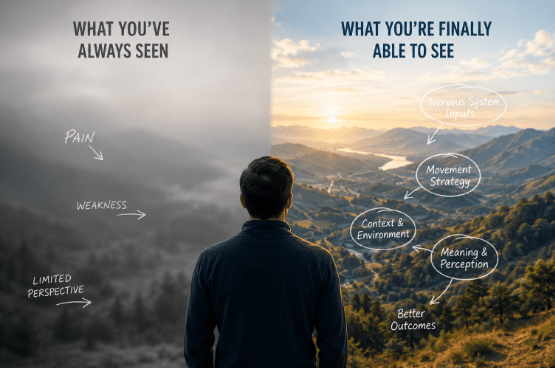
Between what you’ve always seen…
…and what you’re finally able to see.
And the crazy thing is, once you’ve seen it, you can’t unsee it.
What was once obscure becomes obvious.
Patterns emerge where you once saw randomness. You begin to recognize what needs to change, when it needs to change, and perhaps most importantly, why it needs to change.
Many of those who have come through our courses over the years, and now through the Complete Program, are seasoned professionals. They’ve built successful careers, just as I did. They’ve helped countless people.
But they’ve also accumulated failed projects, unresolved cases, and disappointments.
Experience has taught them something valuable.
It’s not about having more techniques.
It’s about having greater clarity.
They’ve come looking for a process that is less definitive and diagnostic, and more speculative, exploratory, and hypothesis-driven. They understand that you rarely know the answer immediately. You arrive at it by following a process that gradually clarifies the map.
Eventually, you realize that much of what you’ve been doing all along has been applying inputs to a system, mostly sensory and motor, while hoping for a better output.
The problem wasn’t that the interventions were wrong.
The problem was that you had no reliable way of validating the process.
No systematic way of broadening your input strategy.
No clear framework for changing direction when proprioception wasn’t the magic solution.
For many of these experienced practitioners, developing a deeper understanding of the neurological system has been transformational.
One comment comes up over and over again.
“Why did I wait so long to learn this?”
It’s usually followed by a little frustration.
Not because they weren’t successful before.
Because they realize how much sooner they could have understood what they were actually seeing.
But we always remind everyone who joins the program:
Learning isn’t about replacing who you are.
It’s about expanding what you’re capable of seeing.
Throughout our final discussion, several practitioners admitted things like:
“I’m not confident enough yet.”
“Some clients resist.”
“I don’t know when to use it.”
“I’m afraid of abandoning what already works.”
Those are universal feelings.
New knowledge almost always creates uncertainty.
That’s normal.
We’re all resistant to change, including our clients.
But eventually, something happens.
You test a new idea.
You see an immediate change.
The athlete moves differently.
The pain decreases.
The movement becomes cleaner.
And suddenly the theory becomes reality.
You’re hooked.
That’s why we tell everyone that confidence doesn’t come from information.
It comes from repetition.
The goal isn’t to become a “brain practitioner.”
It’s to become a better practitioner.
The Complete Reconditioning Experience was never designed to replace your manual therapy…
Your strength coaching…
Or your exercise prescription.
It was designed to help you understand why they sometimes work…
…and why they sometimes don’t.
I’m obviously biased.
But whether you’re early in your career or decades into it, investing in a process that helps bring all of your knowledge together, one that allows you to use every tool you already possess with greater clarity, confidence, and intention, is worth the price of admission every single time.


