Mindset
November 16, 2026 By Scott

When the End is Closer than the Beginning

“…and not, when I came to die, discover that I havd not lived”

-Henry David Thoreau, Walden

One day you wake up and you’re older than you thought you’d ever be.

I realized recently that, in all likelihood, I have considerably less time ahead of me than I have behind me. I’ve always known that death was inevitable. We all know it. But knowing something and feeling the weight of it are different experiences. Somewhere along the way, the end stops being an abstract idea and becomes something you begin to account for.

That realization changes the value of an ordinary day.

When I was younger, I could push things into the future without giving it much thought. There would be another summer, another opportunity, another stretch of time when life would settle down and I could get around to whatever I had been postponing. Procrastination had a cost then, too. I just wasn’t paying much attention to the bill.

Eventually, you begin to recognize that some of the things you want to do have an expiration date. There’s no label telling you when that date will arrive. You may still have the desire when the opportunity passes, but the circumstances, the people, or the physical capacity you need may no longer be there.

I’ve been thinking about that more lately. It’s making me filter more carefully, consider what I agree to, and let go of things I once felt obligated to carry. At the same time, I find myself more open to opportunities that feel worth pursuing. The list of things I still want to experience is becoming clearer because I’m finally asking myself which ones matter enough to make room for.

Time with the people I love belongs on that list. So do good conversations, shared experiences, and relationships in which there is room to be yourself. I’m becoming more aware of how I feel after spending time with someone: connected, curious, and energized, or depleted and wondering why I keep agreeing to the same experience. Relationships require effort, patience, and generosity. I want to invest those things where there is something meaningful to sustain.

I’m also thinking differently about what I expect of my body.

Aging brings change. There are things we lose, things we have to adapt to, and things we may have little control over. I’ve spent enough years working with people to understand that effort doesn’t guarantee health, and a positive attitude doesn’t erase illness or injury. But I’ve also seen how easily we can surrender abilities we still have the capacity to use.

Last year, I reinvested in my physical health. I committed to twelve weeks of P90X, completed it, and then did it again. What followed was one of the toughest summers of my life: selling a house, buying a condo, moving, making improvements, reinventing my working life, and managing all the demands that came with those changes.

I came through that summer with a capacity I don’t think I would have had without the work I had put in beforehand. Being in better shape gave me more energy for the days and more resilience when they became difficult. The investment paid me back in ways that went well beyond how I looked or what I could lift.

Keeping that capacity requires attention. These days, I notice the consequences of letting things slide more readily, and I’m less willing to leave my physical preparation to chance. I made my morning workouts a priority and kept jumping as part of my weekly training. I want to continue asking my body to produce force, respond, and move with some intent.

Over the years, I’ve watched people gradually remove demanding movement from their lives. Sometimes there’s a sound reason. Sometimes it simply disappears because they’ve come to believe it no longer belongs to someone their age. I catch myself examining those assumptions more closely now. What can I still do? What could I rebuild? What have I stopped asking of myself before finding out whether it was actually beyond me?

Those questions extend beyond training.

I also made a decision to become more social. Years spent building businesses had narrowed my world more than I realized. I had become increasingly isolated, and, if I’m honest, increasingly lonely. Since moving back to the city, I’ve spent more time with people whose company I value. There have been good conversations, laughter, and opportunities to share what’s happening in our lives. I had allowed too much of that to fall away.

The work I’ve chosen at this stage of my life comes from a similar desire. I want a different experience, new challenges, and a meaningful opportunity to grow. I still have things to contribute, and I still have plenty to learn. I’m willing to give that process time and effort, while remaining honest with myself about whether the experience is helping me build the life I want.

Today, I decided to begin working toward sprinting again. I want to feel what it’s like to open up my stride and get after it a little. That will take preparation, patience, and respect for where I’m starting. But the idea of having something physical to work toward excites me.

There is still pleasure in discovering what I might be capable of.

I hope to keep that curiosity for as long as I can. I want to keep moving, learning, producing, and spending time with people who matter to me. When my abilities change, I hope I’ll have the willingness to adapt and find something worthwhile in what remains available.

I can’t decide how much time I have left. I can pay closer attention to how I spend it, who I share it with, and what I continue to ask of myself.

There’s still a life to live here. I intend to make it count.

How will you make it count?
READ MORE
Mindset
November 2, 2026 By Scott

Seventeen Years One Extraordinary Journey

“Excellence is not a singular act, but a habit. You are what you do repeatedly.”

-Vince Lombardi

I recently had a chance to sit down with an athlete I worked with for seventeen years. We had some celebrating to catch up on.

Mikaël Kingsbury is the most successful mogul skier in history. One hundred World Cup victories. Twenty-nine Crystal Globes. Five Olympic medals across four Games, including gold in the first-ever Olympic men’s dual moguls event.

The numbers are extraordinary. But after seventeen years beside him, they aren’t the first things I think about.

I think about the teenager who walked into our facility. The athlete he learned to become. The man he grew into. And everything that happened between those first training sessions and one final Olympic run.

I began working with Mik when he was seventeen, shortly before he attended the 2010 Vancouver Olympics as a forerunner. Even then, his skiing offered a glimpse of what might be possible.

That summer, he was in our facility alongside Jennifer Heil and Alex Bilodeau, with an opportunity to see what Olympic champions did when nobody was handing out medals.

It took him a little while to understand what that required.

Talented? Absolutely. But he was still a teenager learning how to become a high-performance athlete. The ability was there. The habits needed some work.

Alex offered a daily reference point. Here was an Olympic champion, training in the same room, showing him what the next level looked like. If Mik wanted to compete with him in 2014, he had some catching up to do.

I remember starting one summer with a little dig about his fondness for McDonald’s. He wasn’t as strong as he needed to be, and I suggested that his current approach probably wasn’t going to make him an Olympic champion.

To his credit, he took the message and did something with it.

He became more intentional about his nutrition. He stepped up in the gym. He began to understand that talent had brought him into the room, but his daily choices would determine how far he could go.

He found another gear, and the results followed.

By the time Sochi arrived in 2014, Mik had become a serious challenger to Alex. Their rivalry brought an interesting energy to the training environment: two exceptional Canadian skiers, each capable of winning, each knowing exactly who stood in his way.

In the end, Alex delivered an incredible Olympic run and defended his title. Mik came home with silver.

When Alex retired, Mik carried that standard forward and continued raising it. He became the benchmark in the sport, year after year. Olympic gold followed in PyeongChang in 2018, then another silver in Beijing in 2022.

Throughout those years, I had the privilege of watching him mature into a leader in his sport and a man of character beyond it.

Something about him always stood out to me.

I’ve worked with people whose pursuit of excellence consumed almost everything around them. Mik could commit himself completely to his sport and still step away from it. He enjoyed his family, his friends, and the people who shared in his journey.

His ambition left room for a life.

I told him that the other night, when we finally had time to celebrate his gold and silver medals from Italy.

By then, his life had another centre of gravity.

At the bottom of the Olympic hill were his son, Henrik, his wife, Laurance, and the Kingsbury clan. They had come to watch him make history.

As it happened, all three medalists in the dual moguls event were fathers. After the competition, they gathered with their partners and children for a photograph.

For all the podiums Mik had stood on, this one held something different.

What most people watching couldn’t appreciate was everything it had taken to get him there.

In late summer, Mik tore an adductor tendon in his left hip while training on the water ramp. Much of the fall became a collective effort to help him recover and prepare for one final Olympic campaign.

There were setbacks. A worsening of the injury in early December. Changes to the competition schedule. Cancelled events that, in hindsight, gave us some valuable breathing room.

Eventually, so much came down to one event in Val Saint-Côme, Quebec.

On home snow, in front of his home crowd, he had the opportunity to win his hundredth World Cup race, secure his Olympic place, and rebuild confidence in what his body could do.

He delivered.

One hundred wins were in the books.

Then came the preparation for the Games, where restraint mattered as much as work.

We kept returning to the same question: What did he need to be ready to win?

Every run had a purpose. Every additional demand had a cost. The minimum effective dose became a very practical way of making decisions.

I remember spending a day on the hill with Mik and his coach, Michel Hamelin, there in case anything needed attention.

I watched him ski like a mogul surgeon. Precise. Efficient. In control.

Then he cased a mogul, and I lost my breath.

He got up and shook it off. I hurried onto the finish area to check on him, and he reassured me that he was fine.

Over dinner recently, he admitted he’d bruised a couple of ribs, but kept it under wraps.

Another thing for him to manage privately. Another adjustment he made before the Games.

Weeks later, I would watch him compete in Italy with pride and trepidation.

I knew what it had taken to reach that start gate. There was satisfaction in the work we had done together, but I also knew how much he wanted the opportunity still in front of him.

In the moguls event, he finished tied for the highest score and took silver on the tiebreaker.

An extraordinary achievement. His fourth consecutive Olympics with a medal.

And still, I knew he wanted gold.

Then came duals.

That day, I saw the champion I had watched emerge so many years earlier bring everything he had learned to one final Olympic performance.

The Mik effect was in full force.

Opponents pushed to stay with him and made mistakes. They lost their lines, ran off course, or missed jumps. Mik kept delivering.

It was an extraordinary spectacle. After everything that had happened over the previous six months, he finished his Olympic career on top of the podium.

And then he went to his family.

When we finally sat down to celebrate months later, the weight of it all had room to settle.

In my profession, you’re fortunate if you get to work with an Olympic champion. I’ve been privileged to work with several.

But seventeen years is a different kind of privilege.

You see the uncertainty before the confidence. The habits taking shape. The setbacks that never make the highlight reel. You have difficult conversations, make adjustments, and keep showing up for the work.

You watch a teenager become a man.

I feel fortunate to have shared that journey with Mik. I also feel a deep satisfaction in having contributed to something we saw through together, alongside so many good people.

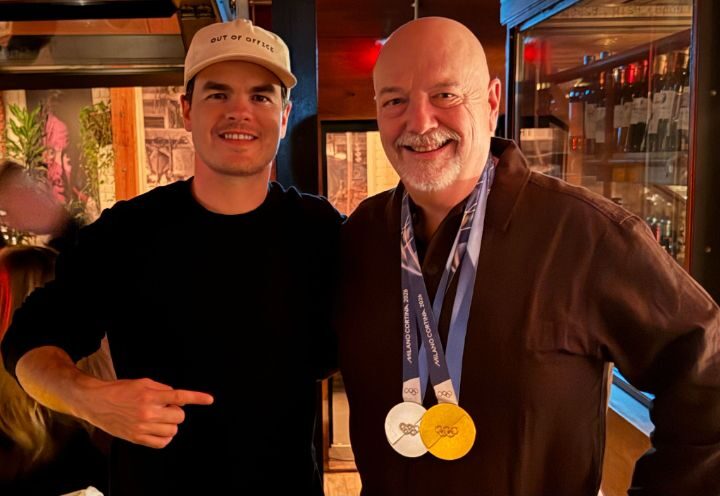
For years, I had a rule: Olympic medals belonged around the neck of the athlete who earned them. However much I might have contributed, I never felt it was my place to wear them.

The other night, I let myself make an exception.

Perhaps, after seventeen years, I was ready to recognize what that journey had meant to me, too.

So I put his medals around my neck.

Mission accomplished.

READ MORE