From Cottage Industry to Community
Industries mature by becoming more specialized. Wisdom matures by becoming more selective.”
-SL
It has been close to forty years now since I first stepped into the world of human performance. In that time, I have had the privilege of watching sports medicine, sports science, and sport performance grow from scattered pockets of passionate people into legitimate professions with their own cultures, research agendas, educational pathways, and industries. Few careers have changed as dramatically over the course of a single lifetime, and in many ways I have felt fortunate to grow alongside them.
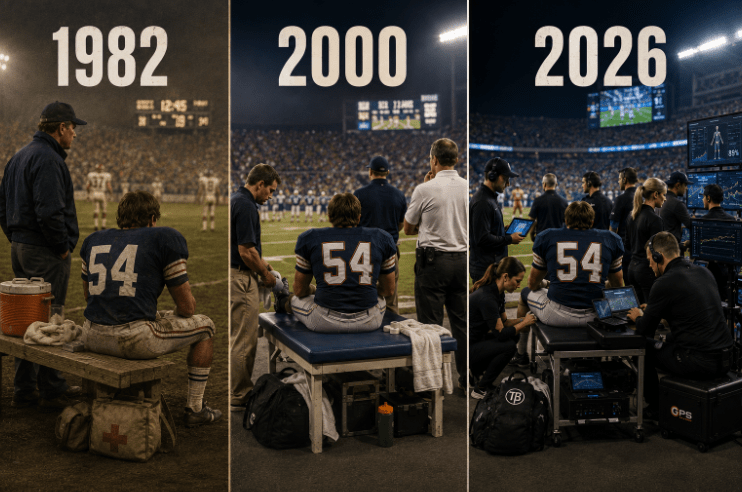
When I was playing high school football in the early 1980s, there was no such thing as a team therapist. Professional teams might have had someone who ran onto the field when an athlete was hurt, but in amateur sport injuries were often managed by a parent with a first aid certificate, a coach doing the best they could, and a great deal of hope.
I remember spraining my ankle badly during my final season of football. The emergency department placed my leg in a cast, handed me a pair of crutches, and told me not to bear weight for six weeks. About three weeks later, I started walking on it anyway. The cast gradually cracked apart, so I took it off myself, and by the following weekend I was back on the football field.
There was no rehabilitation because, quite simply, rehabilitation as we know it barely existed. The only clinic I had ever heard of was housed inside one of the city’s universities. Private sports rehabilitation clinics were virtually unheard of, at least where I grew up. Looking back now, that story seems almost unbelievable, but at the time it wasn’t unusual. It was simply how things were done.
Strength training was equally primitive by today’s standards. It belonged almost exclusively to football players, bodybuilders, powerlifters, and the occasional Olympic athlete. As a young football player, I naturally followed the herd. I fell in love with lifting weights. It fed my youthful ego and, perhaps more importantly, it helped me escape the identity of the overweight kid I had grown up believing I was. Strength became confidence. Bigger became better. Stronger felt like security.
There were no online journals, no podcasts, no systematic reviews, and certainly no social media experts explaining the latest evidence. There were researchers quietly doing remarkable work in universities, but very little of it reached young athletes. Instead, we devoured bodybuilding magazines, searching every page for clues.
Arnold Schwarzenegger. Tom Platz. Frank Zane. Ed Coan. Kazmaier. These men were larger than life. We watched them carrying refrigerators, bending steel bars, squatting impossible weights, and we assumed that somewhere within those pages lay the secret to becoming a better athlete. There was very little guidance helping us distinguish what built a champion bodybuilder from what prepared an athlete for sport. We simply believed that if the best were doing it, we should be doing it too.
As I grew, the profession grew with me.
People who had spent decades laying the foundation for legitimate careers in athletic therapy, strength and conditioning, exercise physiology, and sports medicine were finally beginning to see those professions recognized. What had once been little more than passionate enthusiasts working on the sidelines slowly evolved into occupations that demanded education, certification, clinical reasoning, and accountability.
One of my favourite stories from that era involves Harold Ballard and the Toronto Maple Leafs. The story goes that Ballard hired his boat repairman, who had once served as a medic in the military, to manage the team’s injuries throughout much of the 1980s. Whether every detail is perfectly true hardly matters. The story captures the reality of the time. Expertise often came from experience rather than education because there simply weren’t many educational pathways available.
That began to change rapidly.
Master’s degrees became commonplace. Doctoral research accelerated. Sports physicians specialized. Exercise physiologists entered professional locker rooms. Strength coaches became permanent members of coaching staffs rather than enthusiastic volunteers. Conferences multiplied. Certification bodies emerged. Clinical protocols became increasingly sophisticated. Entire industries appeared around equipment, supplementation, education, surgical techniques, and performance technologies.
Science had finally entered the conversation in a meaningful way.
Growing up in Canada, I suspect we experienced much of this evolution a decade or so behind our American colleagues, but even in the United States the real explosion occurred during the 1990s. Teams gradually realized that arriving at training camp to “get into shape” was no longer acceptable. Preparation itself had become a profession.
Olympic sport had been quietly moving in this direction for years. Coaches had been importing training methodologies from Eastern Europe and the Soviet Union long before professional team sports fully embraced structured preparation. In Canada, the lessons became impossible to ignore after the 1972 Summit Series and the years that followed. We slowly realized that talent alone could no longer overcome superior preparation.
I still remember finding a book in my university library written by Phil and Tony Esposito, two legends of the National Hockey League and members of the Hockey Hall of Fame. Their advice on off-season preparation occupied barely a single page. Essentially, they suggested beginning to run a few weeks before training camp so you wouldn’t embarrass yourself on opening day.
That was considered preparation.
Neither of those extraordinary players built careers in weight rooms. They became all-time greats in an era before structured performance training had truly arrived.
By the time I was completing my education as an athletic therapist, everything was beginning to change. Schools increasingly required therapists at games. Soon they were expected at practices. Eventually, comprehensive clinical models emerged to support injury management throughout the year. The mentors I admired gradually became colleagues. Careers that once felt impossibly distant suddenly appeared achievable.
It was an exciting time to enter the profession because every year seemed to bring another meaningful advancement. Questions were answered, only to create even better questions. Experience met research. Research refined experience. Methods that had once relied upon intuition slowly became grounded in evidence.
Athletes became bigger.
Faster.
Stronger.
Then something unexpected happened.
The conversations at conferences slowly began to change.
More sessions focused on injury. More presentations discussed escalating injury rates, overuse syndromes, surgical reconstruction, chronic pain, workload management, and return-to-play decision-making. For all the sophistication we had introduced, we somehow seemed to be creating a different set of problems that nobody had fully anticipated.
That paradox has fascinated me ever since.
Building greater physical capacity makes perfect sense. Stronger tissues should tolerate greater loads. Better conditioning should prepare athletes for greater demands. None of that is inherently wrong.
But sport is more complicated than capacity alone.
Anything capable of producing tremendous force must also absorb it. Anything capable of accelerating must also decelerate. Principles that work brilliantly in one environment may prove entirely inappropriate in another. The human organism is constantly negotiating the relationship between force, coordination, perception, adaptability, and context. Somewhere along the way, we occasionally mistook one piece of that equation for the entire equation.
The second half of my career has been spent wrestling with that realization.
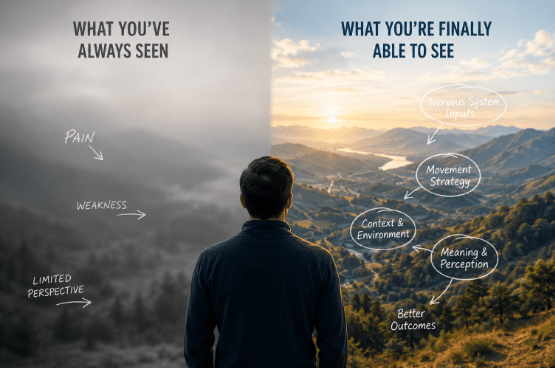
On paper, increasing physical capacity should almost always benefit the athlete. Yet the more people I worked with, the more obvious it became that capacity only matters when the individual can actually access it at the moment it is required. Human performance has never been simply about producing more. It is about producing what is needed, when it is needed, under the constraints that matter most.
The two perspectives are not mutually exclusive. Physical preparation matters enormously. So does exploration. So does movement variability. So does perception. So does context. Extraordinary human performance has emerged from Olympic training centres equipped with every technological advantage imaginable, but it has also emerged from villages with no gyms, no therapists, no force plates, and no sophisticated rehabilitation systems.
Human beings have always possessed an extraordinary capacity to adapt.
Over nearly four decades, I have watched this profession evolve from a cottage industry into a house, then into an entire neighbourhood, and now into a sprawling community filled with remarkable specialists, remarkable knowledge, and remarkable people.
Communities, however, inevitably develop norms. They define averages. They create standards intended to serve the majority.
Elite performance has never cared much for averages.
It lives at the edges.
It demands extraordinary adaptation in extraordinary circumstances, often at costs that are neither healthy nor sustainable. Much of what we have built has unquestionably transformed sport for the better. Some of it has been revolutionary. Some of it has simply become more than necessary.
Perhaps that is inevitable whenever an industry matures.
As I look toward the next decade or two, I find myself less interested in discovering the next great intervention than I am in asking better questions. Not whether we can add another layer of complexity, but whether that complexity truly serves the athlete standing in front of us.
Progress is rarely about doing more forever.
Eventually, maturity asks something different.
It asks us to decide what matters most.